
5 signs your website needs a redesign (and how to do it without losing your rankings)
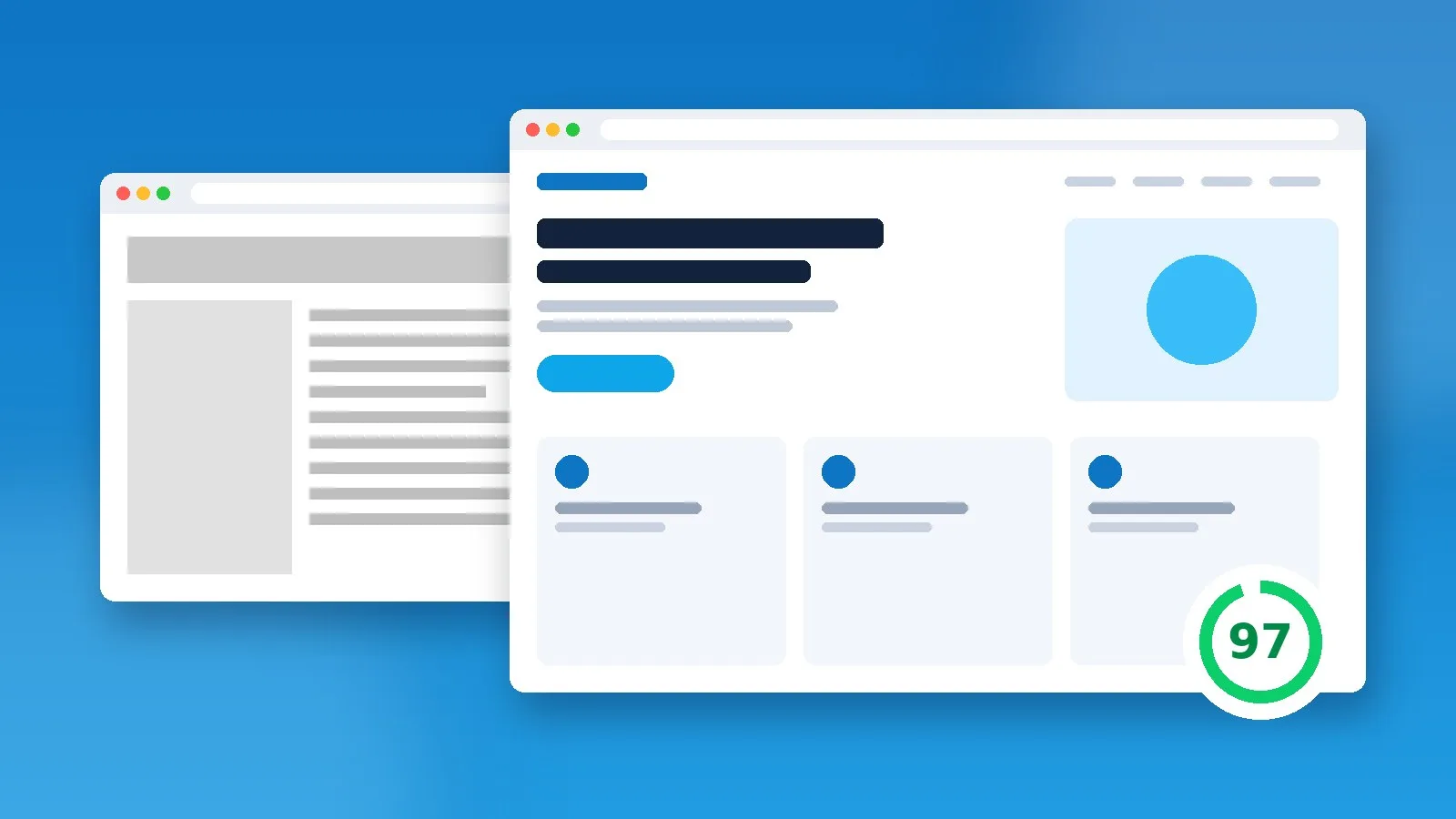
A website doesn't go out of date overnight. It falls behind little by little: a template that no longer fits the brand, a contact form nobody checks, a services page that hasn't been touched in three years. Because the decline is gradual, it's easy to miss until the numbers start to drop.
At Controlnet we review dozens of websites every year for companies that want to grow online. These are the five signs we see most often when a project needs more than a quick facelift.
1. It takes too long to load on mobile
More than half of the traffic on most websites comes from mobile devices, and that's exactly where users are least patient. If your homepage takes more than three seconds to show useful content, a significant share of visitors will leave before they see it.
To check, run your site through PageSpeed Insights and look at the Core Web Vitals: LCP (main content loading), INP (interaction responsiveness) and CLS (visual stability). If they're consistently red or orange, the problem usually lies in the technical foundations, not in a couple of heavy images.
2. Updating a sentence means calling someone
If changing a price, adding a case study or publishing a news item means opening a ticket and waiting days, your website stops being a sales tool and becomes a static brochure. A good content management system should let your marketing team work independently, without fear of breaking the design.
3. The design no longer represents your company
Companies evolve: new services, new positioning, sometimes a new visual identity. When your website is still telling the story of five years ago, it creates a disconnect that visitors notice even if they can't put it into words. Ask yourself: would I proudly send this website to my ideal client today?
4. You get visits, but no leads
Traffic alone doesn't pay the bills. If Analytics shows steady visits but the forms are barely being filled in, check:
Whether your value proposition is clear within the first five seconds.
Whether every key page has a clear call to action.
Whether the form asks for more information than necessary.
Whether there's proof you can be trusted: real case studies, clients, certifications.
5. There are security or maintenance issues
Outdated plugins, obsolete PHP versions, certificates that expire without warning… Each of these is an open door. If your site depends on components that are no longer supported, a redesign is no longer a question of looks — it's a question of risk.
How to redesign without losing what you've already earned
The biggest fear when redesigning is losing the rankings you've built up in Google. The risk is real, but it can be managed with the right method:
Audit first. Export every indexed URL and identify which ones bring in traffic and backlinks.
301 redirect map. Every old URL should point to its new equivalent, never to the homepage by default.
Keep the content that works. Improve it, but don't remove ranking pages without a good reason.
Staging environment. Test speed, forms and tracking tags before going live.
Post-launch monitoring. Keep an eye on Search Console for the first few weeks to fix crawl errors early.
A well-planned redesign shouldn't cost you traffic: it should be the starting point for getting more.
Does your website show any of these signs?
If you recognised two or more of them, it's probably a good time to rethink your project. At Controlnet we can carry out an initial review of your website and tell you, with no obligation, what's worth improving and what's worth keeping. Get in touch and we'll look at it together.